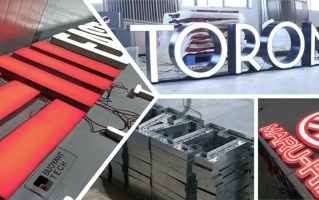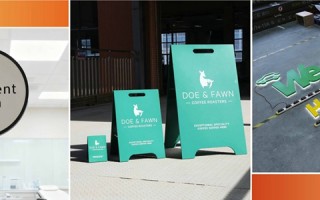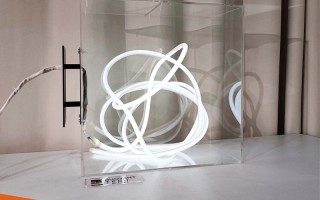
Every time you pass by a shopping mall and see those floating three-dimensional guide signs, or walk into a science and technology park and be shocked by the futuristic building signs, will a question suddenly pop up in your mind?: Who designed these cool 3D logos? Is it magic? No, behind it stands a role that you may not know much about, but is very important - a 3D designer of logos and signage.
.jpg "标识标牌3D设计师,到底是谁在造梦?")
This person is not as simple as you think who only immerses himself in building a model with software. He/she is more like a "cross-border dream maker" and must be a visual translator Party A's dad (or colleagues from the marketing department) brought a bunch of abstract concepts, such as "the company should embody a sense of technology, but also have a humanistic touch" and "should be eye-catching, but not too obtrusive." These ideas floating in the air have to be grounded by the 3D designers and turned into concrete forms, materials, light and shadow, and spatial relationships. They have to "render" it in their minds first, and then use professional tools to realize it.
He/She must be a Half engineer and materials expert , just looking good isn’t enough! A large outdoor 3D sign looks beautiful when rotated on the computer, but can it stand upright in reality? What materials are used to achieve it? Metal? Acrylic? Or new composite materials? What are the effects of different materials under different lighting and weather? How does the structure bear force? How to reserve the installation point? If the designer does not understand these practical issues, the design may be a "waste draft" that will stay on the screen forever. A good 3D designer will communicate closely with the subsequent production team, and even need to understand some processing techniques to ensure that his "dream" can be made and established.
.jpg "标识标牌3D设计师,到底是谁在造梦?")
He/she must also be a Space experience planner , the sign does not exist in isolation, it is embedded in the environment. If this 3D sign is placed in this square, what is the perspective when looking from the main direction of pedestrians? How to balance the visual effects during the day and at night? Does it conflict with or integrate with the architectural style behind it? Designers can't just stare at the sign in front of them. They have to jump out of the screen and repeatedly simulate the walking and viewing experience of people in the real environment in the virtual space. In order to get the best viewpoint, they have to adjust the angle and proportion countless times in the software.
Where are these people usually located? They may be lurking in professional Logo Design Company Here, this is the main force, it may also be in Brand visual department of large enterprises , to unify the image of their own campus or global stores, and some, in Advertising planning company or Exhibition display company , it is also indispensable to create temporary shocking signs for specific activities or exhibition halls. freelancer , relying on good skills and unique creativity to take on various interesting projects.
When it comes to their tools, they are really good at eating. Mainstream tools like 3ds Max and Cinema 4D are used for modeling and rendering to create realistic textures. ; Rhino, combined with Grasshopper, is particularly good at handling complex parametric and special-shaped structures. ; SketchUp is also commonly used to quickly refine shapes, but the software is just a pen, and the most important thing is what is in their minds. Spatial imagination, aesthetic literacy and a deep understanding of logo functions .
This profession is interesting, but also quite "brain-burning". You often have to find a balance between the unbridled creativity and the cold reality of craftsmanship, and "jump" repeatedly amidst the changing opinions of the client and the tight deadline of the project. Whenever they see the 3D logo they designed "walk" out of the screen, truly standing in the city, guiding the direction and becoming part of the scenery, that sense of accomplishment is probably the reason why they persist.
The next time you are attracted by an exquisite 3D logo, you might as well take a second look. Behind it is a "dream maker" who combines art, design and engineering thinking. They silently build our visual road signs between virtuality and reality. They are not magicians, but they use pixels and parameters to truly change the world around us.
.jpg "标识标牌3D设计师,到底是谁在造梦?")