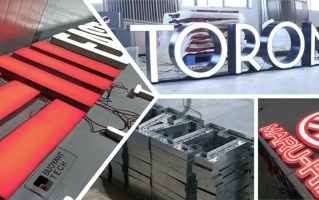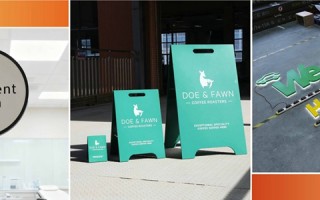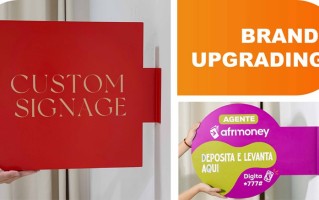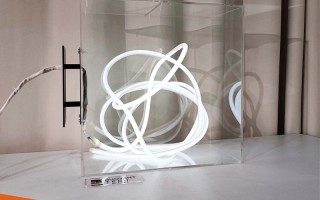
Hey, friends in the design circle and colleagues in the signage industry, have you noticed that street advertising signs have become more and more "three-dimensional" recently? It is not the traditional flat printing with a little raised effect, but a three-dimensional work that can be truly appreciated from all angles. Yes, this is the new change that 3D printing technology has brought to the advertising signage industry. Today we will talk about 3D printing advertising signage design drawings - how to turn wild ideas into eye-catching street art.
.jpg "3D打印Advertising signs
设计图,从概念到实物的创意革命")
I remember that five years ago, I visited a design exhibition and saw the first signage sample made with 3D printing technology. I still remember the shock. It was a three-dimensional signboard for a cafe. The heat coming out of the coffee cup was solidified. When the light and shadow hit it, the whole sign seemed to come alive. At that time, I was thinking, if this technology is popularized, how much will our industry change? Unexpectedly, the changes will come so fast.
A leap in design freedom
What are the biggest limitations of traditional signage design? It’s the production process. Many wonderful ideas often get responses from factory masters like: “"This can't be done", "That cost is too high", "This kind of arc machine can't come out", but 3D printing has broken almost all limitations. Recently, our team took on an aquarium project. They wanted a sign that seemed to be naturally formed by water flow. In the past, this organic form was almost impossible to achieve through traditional processes, but now we "carve" the water flow texture directly in the 3D software. After printing, the natural flow makes the customer amazed.
But don’t think that everything will be fine with 3D printing. The preparation of design drawings is more demanding than the traditional method. You have to truly understand the three-dimensional space, instead of mainly considering the flat effect like before. A friend of mine made a joke when he tried it for the first time - he designed a super complex three-dimensional character, which looked very domineering from the front. The result was as thin as a piece of paper when viewed from the side, and could not support the shape at all. So, three-dimensional thinking is the foundation of the foundation.
The pitfalls of software and technology
When it comes to design software, there are quite a few to choose from now. Blender, Rhino, 3ds Max, and ZBrush all have their own strengths. I personally prefer Rhino. Its curve modeling capabilities are particularly suitable for objects such as signs that require precise dimensions. However, novices may be intimidated by these softwares - the interface is complex and there are many tools. My suggestion is, don’t be greedy for too many, master one first. It’s like learning to draw. If you have a good foundation in sketching, you can get started quickly with oil painting and watercolor.
Exporting files is also a technical task. The STL format is the most common, but if the export settings are wrong, there will be problems when printing. I remember the first time we exported the file ourselves, the surface looked perfect, but when we printed it, we found that it was all broken. Later we found out that there was a problem with the grid density setting. If no one reminds us of these small details, we really have to go through the pits several times to understand them.
.jpg "3D打印Advertising signs
设计图,从概念到实物的创意革命")
Material selection is another big question. PLA material is cheap and easy to use, but its outdoor durability is average. ; ABS has high strength, but has strict requirements on the printing environment. ; The recently popular PETG is a good compromise. If it is a large outdoor sign, we usually consider nylon materials or resin materials, and then cooperate with post-processing technology. By the way, when it comes to post-processing, this is the "makeup" of 3D printed signs, including polishing, coloring, spray painting, and distressing effects - the same print, different post-processing, the effect is very different.
The balancing act between cost and efficiency
Many people think 3D printing is expensive when they hear it. In fact, it depends on the comparison. If it is a simple flat sign, the traditional method is indeed more economical, but once it involves complex three-dimensional structures, 3D printing may actually be more economical - because it reduces the cost of molds and is especially suitable for small batch customization. Last week we just completed a project for an art gallery. They needed 12 completely different three-dimensional signs. If the mold is made using the traditional method, the cost will be sky-high. However, with 3D printing, each design is printed separately, and the total cost is controlled quite well.
There is also an advantage in time. The cycle from design to production of traditional signs is often measured in weeks, while with 3D printing, the preparation of complex design drawings may take several days. However, once printing begins, small and medium-sized signs can be produced in a day or two. For customers who are in a hurry, this advantage is too obvious.
However, I have to remind you that not all signs are suitable for 3D printing. Ultra-large outdoor billboards are still dominated by traditional crafts. 3D printing is more suitable for small and medium-sized scenes that emphasize design and uniqueness - such as brand flagship stores, exhibition displays, and commercial space decoration.
The future is here
Recently, I have noticed in several shopping malls that more and more brands are starting to use 3D printed signs. There is a sports brand that uses the cross-sectional structure of running shoes to make three-dimensional signs, and the effect is shocking. ; There is also a dessert shop where the signboard is made into layers of cream, which makes people appetizing when viewed from a distance.
.jpg "3D打印Advertising signs
设计图,从概念到实物的创意革命")
This industry is changing so fast. Color 3D printing technology is becoming more and more mature. In the past, it required post-coloring work, but now it is printed directly with color. Large-scale 3D printers are also developing, and the sizes that can be printed are getting larger and larger. I heard that some companies are already trying to print three-dimensional advertisements on the entire wall.
But no matter how the technology changes, the core is still design. 3D printing has given us unprecedented realization capabilities, but in the end, it is the creativity itself that touches people's hearts. Just like having the best brushes and paints, it is useless if you cannot draw good paintings.
Some suggestions for friends who want to try it
If you’re getting ready to try 3D printed signs, I have a few tips: First, start with a simple design and don’t challenge the difficulty as soon as you get started. ; Second, find a reliable printing service provider to cooperate with. They can provide a lot of practical suggestions. ; Third, you must make samples. Looking at the computer and holding the real thing in your hand are completely different things. ; Fourth, consider the installation method. The installation of three-dimensional signs is much more complicated than flat ones, so it is best to take it into consideration at the design stage.
By the way, one more important thing is to understand the installation regulations of local advertising signs. Some cities have strict restrictions on the thickness and protruding distance of outdoor signs from the wall. These must be taken into consideration during the design, otherwise no matter how beautiful the design is, the approval will be in vain.
3D printing is redefining what is “possible.” Those dreamy concepts that once only existed on design drafts are now becoming reality one by one. As a member of the signage industry, I feel both pressure—to constantly learn new things—and excitement—we are participating in shaping the urban visual landscape of the future.
Next time you are walking on the street, you might as well pay more attention to the signs around you. Maybe the three-dimensional signboard that makes you can't help but look at it twice was "grown" by a designer who stayed up in front of the computer for a few nights and then "grew" it bit by bit through a 3D printer. In this era, good designs can finally move from the imaginary world into the real world with almost no loss. Isn't this exciting?
Okay, that’s it for today. If you have interesting experiences with 3D printed signs, or have encountered any headaches, please share them. Our industry is constantly moving forward through communication. Next time I plan to talk about the lighting design of 3D printed signs - how to make these three-dimensional works sparkle at night. See you then!