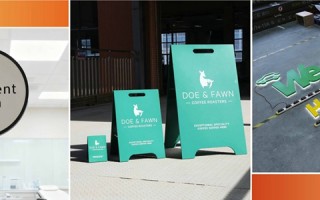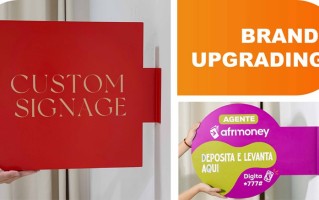
When walking on a commercial street, have you ever been attracted by those three-dimensional signboards that seem to jump out of the wall? This is the magic of 3D logo signage. As a website editor, I often receive questions from readers.: “How to make 3D logo signage? ”I will combine my many years of observation and industry experience to break it down and talk about it for everyone.
first step: Don't rush into action, think about these things first
When making 3D signs, the biggest fear is working hard right away. You have to understand a few key issues first.:
Where will this logo be placed? Indoor or outdoor? If it is outdoors, weather resistance must be considered ; If it is indoors, you may pay more attention to beauty and details.
.jpg "3DSignage Design
全攻略,从创意到落地的实用指南")
Who is the target audience? The cool style that young people like and the elegant texture that high-end brands require are completely different things. I have seen a cafe that used particularly avant-garde 3D metal characters. As a result, all the people who came were middle-aged people who wanted to drink coffee quietly, and the atmosphere did not match at all.
What's the budget? To be honest, the price range of 3D signs is too big. A simple three-dimensional acrylic letter may cost a few hundred yuan, but if it is a large metal hollow sculpture-style sign, it may cost tens of thousands or even hundreds of thousands. Only by determining the budget range can you choose the appropriate materials and processes.
What feeling do you want to convey? A sense of technology? Retro style? Or warm and friendly? The answer to this question will directly affect the direction of your design.
Step 2: Design stage – how ideas turn into drawings
Okay, now you probably have the idea in mind, the next step is the design process, here are a few practical suggestions:
You don’t have to be fancy when choosing software Many people think that they have to use particularly professional 3D software. In fact, this is not the case. For most logo designs, flat software such as Photoshop and Illustrator plus some simple 3D functions are enough. If you want to do particularly complex modeling, you may need to learn professional tools such as Rhino, 3ds Max or Blender.
Proportions and sizes need to be carefully considered The effect on the design draft is often different from the look and feel after actual installation. I recommend that you make a 1:1 simulation drawing, or at least make a scaled-down model to see the effect. A customer once designed a three-dimensional character that looked beautiful from the front, but after installation, he found that it was very thin from the side. This was due to poor consideration in the early stage.
Materials and workmanship should be considered in advance When designing, you have to think about what material to use. Is it metal? Acrylic? Or wood? Different materials will affect the achievability and final effect of the design. For example, if you want to make particularly thin strokes, it may be fine if you use metal, but it may break easily if you use acrylic.
Don’t forget readability This is a mistake that many designers tend to make - in order to pursue a cool effect, the characters are designed to be unrecognizable. The primary function of a logo is to convey information, followed by aesthetics, especially commercial logos. If customers don’t know what you are selling after looking at it for a long time, then the design will fail no matter how beautiful it is.
Step 3: Manufacturing process - how designs become objects
After the design draft has been approved, the next step is the production process. There are many ways to do this.:
Be particular about material selection
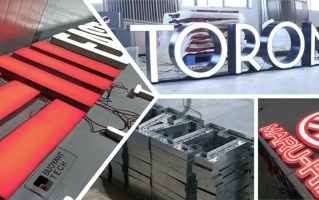
Metal : Stainless steel, aluminum plates, and copper plates are all common. Stainless steel is durable but expensive. ; Aluminum sheets are lightweight and easy to process, making them suitable for large signs ; Copper plates have a unique retro texture, but require regular maintenance to prevent oxidation.
Acrylic : It has rich colors and good light transmittance, and is especially suitable for signs that require internal lighting. However, it may turn yellow after being used outdoors for a long time.
wood : Natural and warm, but antiseptic treatment needs to be considered, especially for outdoor use.
New materials : For example, the resin used for luminous characters and the polymer materials used for mini characters have their own characteristics.
Craftsmanship determines texture
Cutting process : Laser cutting has high precision and is suitable for complex graphics ; Waterjet cutting is suitable for thick materials ; Plasma cutting is often used for large metal signs.
surface treatment : Metal can be polished, brushed, sandblasted, and electroplated ; Acrylic can be polished around the edges to create a crystal-like effect.
Three-dimensional molding : Bending, welding, splicing, multi-layer superposition...different techniques can create completely different three-dimensional effects.
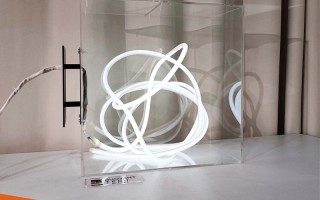
Lighting design is important Many 3D signs also have to function at night, so the lighting design cannot be ignored. Is it external lighting or built-in light source? LED or neon lights? How to control light color and brightness? These will affect the final effect and energy consumption. I have seen a hotel sign that looks high-end during the day, but when the lights are turned on at night, the brightness is uneven and the cheap feeling immediately comes out.
Step 4: Installation and maintenance - don’t be careless in the last step
It was finally done, but it would be a pity if something went wrong during the installation process.:
.jpg "3DSignage Design
全攻略,从创意到落地的实用指南")
The installation location must be inspected on site You may think it's a good place when you design it, but when you actually arrive at the site, you find that there are pipelines blocking it, or the walls are not load-bearing enough. You must make on-site measurements and surveys in advance.
The fixing method must be safe and reliable Especially for large outdoor signs, wind resistance must be taken into consideration. There was once a large three-dimensional sign in a shopping mall that fell down on a windy day because it was not firmly fixed. Fortunately, no one was hit.
Maintenance should be considered in the long term When designing, you must consider future cleaning and maintenance. Some designs may look cool, but there are too many grooves that easily accumulate dust, making cleaning particularly troublesome. Outdoor signs must also consider issues such as rainproofing, rustproofing, and ultraviolet protection.
A Guide to Avoiding Pitfalls: The rollover cases I've seen
After doing content for so many years, I have collected many failure cases of 3D logos. I will share a few here. I hope everyone can avoid these pitfalls.:
The tragedy of disproportion One restaurant made a huge 3D food model as a logo. It was a good idea, but it was too big. It looked fine from across the street, but when I got closer, it just felt depressing and completely lost my appetite.
The embarrassment of excessive lighting There was a sign for an office building that used very bright LEDs, which really stood out at night. However, residents across the street complained about light pollution and had to be dimmed, greatly reducing the effect.
The consequences of ignoring the environment There was a B&B in an ancient town that had a particularly modern three-dimensional metal character. It looked quite stylish on its own, but it was incompatible with the surrounding ancient buildings. In the end, it had to be demolished and redone.
Be greedy and suffer big losses In order to save money, a customer chose the cheapest materials and workmanship. As a result, it faded and deformed after less than a year of outdoor use, and the repair cost was more expensive than if it had been done better in the first place.
future trends: What other tricks can 3D logos play?
Finally, let’s talk about the new trends in the industry. Now more and more 3D logos are beginning to incorporate new technologies.:
dynamic elements It is no longer static three-dimensional characters, but movable parts are added, such as slowly rotating elements, or display content that changes according to time and weather.
Interactive functions Touch sensing and gesture recognition make the logo not only visible but also interactive. I have seen a museum logo that displays more exhibit information when your hand is close to it.
Environmentally friendly materials Recyclable materials, solar lighting, and green environmental protection are gaining more and more attention.
digital convergence The physical 3D logo is combined with AR technology, and you can see the virtual expanded content by scanning it with your mobile phone.
In the final analysis, 3D signage design and production is a comprehensive job that requires a balance of creativity, technology and practicality. It is not as simple as turning a flat design into a three-dimensional one, but rather considering spatial relationships, material characteristics, process limitations and actual usage scenarios. I hope this article can give you some real inspiration. If you have specific projects you are planning or encounter any problems, please feel free to communicate and discuss. After all, behind every good logo is the result of countless thoughts, attempts and adjustments.