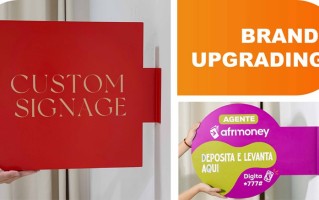
I wonder if you feel this way? Walking on the street, you can see all the billboards and signboards, eight out of ten of them are similar in appearance - a square bottom board with a few posters or a few lines of words on it, regular but unremarkable. They just "lay" there, waiting for people to glance at them accidentally. More often, they are just background boards passing by in a hurry. The information is conveyed, but it seems that they do not leave any impression, let alone people taking the initiative to approach and stop to take a closer look.
What's the problem? I think that many times our thinking is "framed". When we talk about logos and bulletin boards, the first thing that pops up in our minds is a two-dimensional plane. But the real world is three-dimensional, and the way people perceive the world is also multi-dimensional. If you want your information to not be overwhelmed, you have to let it "jump" out of the flat frame, and 3D design is the most direct and powerful "spring".
.jpg "别再用平面思维了!3D标识标牌宣传栏,让你的信息跳出来")
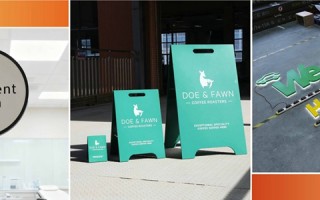
First of all, you must understand that 3D design is not just as simple as "making a thickness". In the early years, some understandings may have been limited to adding a raised shadow to the text or logo, which was considered 2.5D at most. The 3D signboards we are talking about now are holistic three-dimensional thinking from structure, space, material to light and shadow. It makes the information itself become part of the space, and even creates a new, miniature visual space.
If the cultural bulletin board of a community is just tiled with photos and text, you may just pass by it. However, if a layered three-dimensional hollow structure is used to superimpose the silhouettes of the community's old buildings and tree outlines in an orderly manner, and match the real light and shadow changes, the morning and evening sunlight will cast on the back. By casting different shadows, the entire bulletin board becomes "alive". It is no longer just a carrier of information, but has become a small landscape that tells the story of the community. It attracts people to walk over, look at the light and shadow, and naturally see the content you want to convey. This kind of experience cannot be given by any graphic design.
.jpg "别再用平面思维了!3D标识标牌宣传栏,让你的信息跳出来")
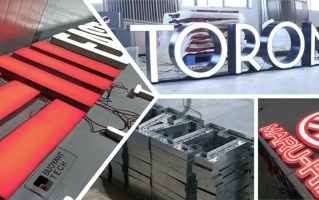
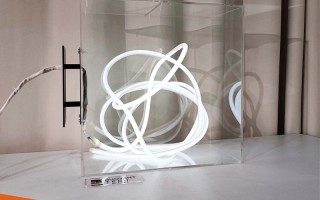
The "collision" of materials and craftsmanship is the soul of 3D design. Flat printing mainly plays with colors and patterns, while 3D entities are a symphony of materials. The cold and sharpness of metal, the transparency and warmth of acrylic, the simplicity and kindness of wood, the thickness and eternity of stone, and even combined with lights (LED internal lighting, contour light, projection, etc.), can show completely different expressions at different times and in different weathers.
Imagine a guide sign system for a science and technology park. It adopts a streamlined three-dimensional metal structure, with a delicate brushed surface. The key information part uses internally luminous acrylic. It looks simple and modern during the day, and outlines a clear technology light belt at night. This not only tells you "where to go", but also silently conveys the temperament of this park.: Innovation, precision, and a sense of the future, the penetration of this brand image is subtle and extremely profound.
.jpg "别再用平面思维了!3D标识标牌宣传栏,让你的信息跳出来")
What's more important is interactivity and memory points. People are naturally more curious about three-dimensional and touchable things. A well-designed 3D bulletin board can break the single dimension of "viewing" and trigger the desire to "explore". A science bulletin board in a child-friendly park can display models of insects or plants. It is presented as a body, some parts can be gently rotated or touched, and text explanations are cleverly arranged around the structure. Children will take the initiative to touch and play, and naturally absorb knowledge during the interaction. The memory intensity of this process is much deeper than reading words on a tablet.
Engaging in 3D design is not just about pursuing complexity and showing off skills. The core of a good 3D logo signboard is still the integration of functionality and environment. The three-dimensional structure cannot hinder information recognition or cause safety hazards to pedestrians (such as sharp convex corners). Its shape, style, and color must coexist harmoniously with the environment (whether it is a modern shopping mall, a historical district, or a natural scenic spot), or even improve the quality of the environment. It should "grow" out of the environment, rather than being "sticked" to it.
From the perspective of production and production, this means higher requirements for design and construction. The design phase requires full consideration of three-dimensional models, structural mechanics, material matching, process realization and post-maintenance. Production and processing rely more on precision laser cutting, three-dimensional engraving, metal welding and bending, multi-layer composite assembly and other processes. It may seem troublesome, but the value increase is huge.: Stronger visual appeal, deeper brand impressions, longer audience dwell time, and ultimately – more effective messaging and traffic conversion.
If you are still troubled by the fact that no one is looking at the billboard and the signboard is inconspicuous, it is really time to change your thinking. Stop letting your information "lay flat" and roll in in the two-dimensional world. Try to use 3D thinking to inject space, material and interactive soul into it, so that it can truly "stand" and "jump" out. When your signage billboard becomes a scenic spot that passers-by are willing to take photos and check in, are you still afraid that your message will not be conveyed? These days, attention is the scarcest resource, and an excellent 3D design is the most powerful "attention catcher" on the street.