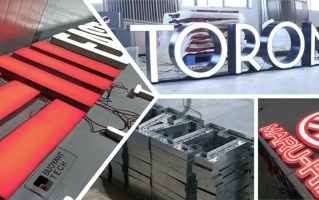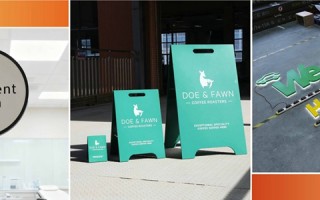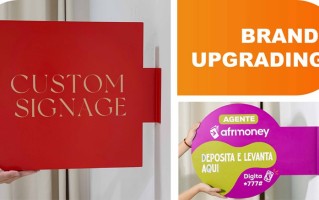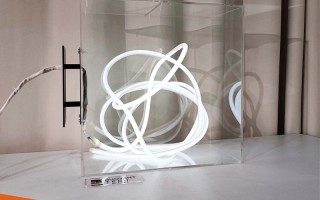
Recently I was chatting with a few friends who run physical stores and found that we all have a common pain point.: If you want to make a signboard or interior sign, the process is too complicated. Find a design company. The price is high and the communication cycle is long. There will be a lot of back and forth on changing the plan. ; If you use ordinary software to figure it out, the effect will not come out, and the final product will always be less interesting, and the money spent will not achieve the desired feeling. This problem actually exists in the signage industry for more than a day or two.
Until I had an in-depth experience with the 3D cloud design platform launched by "Ice Fox Logo" a while ago, my eyes brightened. This thing is a bit interesting. It is not like those high-end professional software, the threshold is scary high. ; Unlike some overly simple online tools that can only scratch the surface, it seems to have found a balance point - moving professional design capabilities into our browsers in a more friendly and flexible way.
Say goodbye to "talking on paper" and enjoy the joy of what you see is what you get
.jpg "冰狐标识标牌3D云设计平台,让创意自由生长,把专业交给云端")
In the past, when we discussed signage plans, we mostly looked at graphic design drawings and relied on imagination to figure out the three-dimensional effects, material textures, and environmental integration after installation. It often looked beautiful on the drawings, but when the actual thing was made and installed on the wall, we discovered that the proportions were wrong, the color was off, or it was incompatible with the surrounding environment. That was very frustrating.
The first thing that struck me the most about the Ice Fox platform is the true "3D visualization". What you design is a three-dimensional sign. From beginning to end, you play with it in a three-dimensional space. You draw a rectangular parallelepiped as the base, choose a font to type in the store name, and change the material such as imitation wood grain or Brushing metal, adjusting thickness, curvature... all operations, the rendering window on the right shows the effect in real time, from which angle the light is struck, how the reflections of different materials are, and even the background environment (such as whether it is placed on a brick wall or a glass curtain wall) can be simulated roughly.
This kind of experience is like looking at a house floor plan and suddenly turning into an immersive decoration simulation game. You can rotate the perspective at any time, get closer to see details, and zoom out to see the overall atmosphere. For shop owners or friends from the marketing department, this is too friendly. Decision-making is no longer based on abstract lines and color blocks, but on a nearly real "digital sample". When communicating with the production factory, it also saves a lot of words, "Here, just do it according to this 3D effect." It is simple and direct.
“"Building block" design returns the creative initiative to you
I particularly like one of its design ideas: Modular and parametric, the platform has a rich material library, which contains the "basic components" of various signs in categories, such as base plates of various shapes (rectangular, circular, special-shaped), font libraries of different styles, common icons (arrows, phone calls, Wi-Fi symbols, etc.), and decorative elements.
You can drag these parts onto the canvas like building blocks and assemble them freely. What's even better is that each part can be "unscrewed" and fine-tuned. For example, if you select a text, you can not only change the content, font, and color, but also individually adjust its raised height, tilt angle, and edge chamfer arc. The same goes for the base plate, thickness, material, color, and you can even upload your own pattern or LOGO for UV mapping.
.jpg "冰狐标识标牌3D云设计平台,让创意自由生长,把专业交给云端")
This gives users huge creative flexibility. You don’t have to draw a line from scratch, but create based on reasonable and producible structural modules, which not only ensures the process achievability of the final work (after all, these modules correspond to real-life processing methods), but also does not restrict your ideas. Whether you want to make a retro-style bronze medal, a minimalist acrylic luminous letter, or a hollow logo full of technology, you can find the corresponding "building blocks" to build and adjust.
Cloud collaboration breaks the walls of time and space
“The word "cloud" is the key. It is not just as simple as putting the software on a web page. It means that all your design projects are automatically saved in the cloud. You can continue working on the Internet anytime and anywhere. Today, you can do half of it on the office computer, save and close it, and use your tablet or laptop at home in the evening. Just log in and continue. This advantage is even more obvious for situations that require teamwork.
The marketing department writes the copy, the design department is responsible for the styling, and the final decision is submitted to the boss for review. In the traditional process, files are passed around and version numbers are messed up. On the Ice Fox platform, you can share design links and set different viewing or editing permissions. Everyone can provide comments and make modifications on a unified, latest 3D model. All dynamics are clear and followable, and we say goodbye to the "final version"_v5_Really final version_Modified version" is a troublesome file naming.
This is also good news for logo production factories. What the customer ultimately confirms is no longer a bunch of floor plans and dimensional drawings that may cause ambiguity, but a complete cloud solution that contains all three-dimensional data and material information. The factory can directly obtain accurate data for subsequent production such as CNC engraving, bending, and welding, which greatly reduces errors and rework caused by misunderstandings.
The bridge between reality and virtuality, pre-assessment of costs and risks
.jpg "冰狐标识标牌3D云设计平台,让创意自由生长,把专业交给云端")
When making physical signs, the choice of materials and processes is directly related to cost and effect. The Ice Fox platform has worked hard on the material library, which not only provides common options such as acrylic, stainless steel, aluminum plates, PVC, etc., but more importantly, its rendering engine can better simulate the true look and feel of these materials - the cold mirror feel of stainless steel, the warm texture of wood, and the uniform halo of luminous characters.
What's the use? Can you conduct a full "virtual trial" before placing an order for production? Are you hesitating between two materials? Then render them separately and compare them. Are you worried that the luminous characters are not eye-catching enough during the day? Then brighten the light in the rendering environment and simulate it, and you can even make a preliminary estimate of the relative costs of different material combinations.
This is equivalent to moving part of the "trial and error" process from the expensive physical prototyping stage to the zero-cost virtual design stage, helping users make more reasonable and economical choices in the creative stage and avoiding many subsequent regrets and disputes.
Talk about shortcomings and prospects
Of course, nothing is perfect in the world. The platform of Ice Fox may still be a bit difficult for complex sculpture-type logos that pursue extreme personalization and strong artistry. Its advantage lies in standardized and semi-customized logos in commercial environments. Although the material library is constantly enriched, users will always look forward to more and more fashionable templates and material choices.
I think its direction is right. It lowers the threshold for professional logo design, but does not lower the quality of the work. ; It improves the efficiency of communication and creation, and brings designers, customers, and producers on the same channel. It is more like a powerful "creative amplifier" and "communication router."
A logo is a "sentence" in a space that silently tells the story of the brand. The 3D cloud design platform of the Ice Fox logo gives me the feeling that it provides a more convenient "pen" to everyone who wants to tell a good story. It makes the birth process of creativity more intuitive, freer and more collaborative.
Perhaps, the future logo design industry will become more and more like this: Professional capabilities have become like water, electricity and coal. Through the infrastructure of "cloud", they are provided to those who need them in an approachable manner. What matters is not how complex the software you master, but whether you have good ideas, and good tools are the soil that allows ideas to get rid of constraints and grow freely.
If you are also troubled by the tedious process of logo design and production, maybe it is time to go to the cloud and take a look. There may not be real foxes there, but maybe there is magic hidden there that can make your sign "alive".