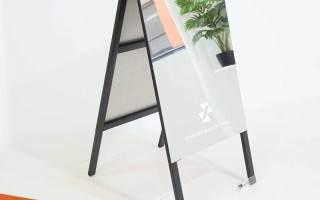
Recently, I was chatting with several colleagues who are doing campus projects, and everyone invariably mentioned the new campus identification system of Yangjiang University. It was not a hard-edged "praise from Party A", but a bit thoughtful.: “Hey, the design of their building index sign is a bit interesting. ”“Did you notice that they even have very particular signs on the trash cans? ”This aroused my interest. Isn't the logo of a university just a guide? What other flowers can it be made into? After further understanding, I discovered that the system of Yangjiang University is really not a simple "production", but an in-depth thinking about the campus temperament and functional experience.
.jpg "阳江大学标识标牌制作,如何让校园导视系统既好用又有品?")
First of all, it must be said that the challenges facing Yangjiang University are very typical. The new and old campuses are integrated, large in area, and complex in functional areas - teaching buildings, laboratory buildings, living areas, sports venues, and small gardens with winding paths. Different groups of teachers, students, visitors, and family members have different needs. The initial pain points are obvious: Checking in for freshmen is like navigating a maze. The courier boy has to make three calls to find the dormitory building. Scholars from outside the conference have to "follow the crowd" to go to the lecture hall. The school's initial thought may have been to "hurry up and make a batch of signs to make the road signs clear." However, the teachers in charge of this project were very thoughtful. Instead of rushing to find the manufacturer to place an order, they first formed a small team and started working as "campus detectives."
They did something stupid but very effective: Simulate the walking paths of different people on the spot. What is the fastest way for students to rush from the dormitory to the teaching building in the morning? Which door do parents drive through? How do they find the administrative building after parking? Are the routes accessible to people with disabilities? As soon as these trajectories are superimposed, the problem arises: Which intersection is a "decision-making fatigue point", where is a traffic congestion point, and which corner is difficult to see clearly in the light of the sign in the evening. You see, the starting point for good sign production is not the "brand itself" at all, but "human behavior", which determines the tone of all subsequent work - not decoration, but accurate "space translation".
Based on this "reconnaissance report", the design idea became clear. The first impression that Yangjiang University's logo gave me was “Discernment in restraint” , instead of abusing the school emblem and standard colors, we extracted a certain kind of brick red that is common in campus buildings as an embellishment color. Dark gray and matte white are used in large areas, and the materials are also very careful. The outdoor main index board is made of thick brushed stainless steel, which is highly weather-resistant and has a solid texture that will not look dilapidated even after being exposed to wind and rain for several years. ; In the indoor area, a warmer composite aluminum plate is used, and the edges are rounded to prevent students from bumping into them in a hurry. The font size and line spacing have been carefully considered to ensure that key information can be captured at a glance even when walking quickly.
.jpg "阳江大学标识标牌制作,如何让校园导视系统既好用又有品?")
What’s even more interesting is the way they handle “multi-layered information,” such as a comprehensive sign at an intersection that tells you in clear layers: first sight , see the general direction of the main functional area you want to go (teaching area, living area) ; Get closer and take a closer look , is the specific building name and arrow ; bottom , there may also be a line of small text prompting "There is a cafe 50 meters ahead" or "Leading to the lakeside reading area." This design not only solves the need for immediate wayfinding, but also quietly conveys campus cultural information, implying that this is not only study, but also life and leisure.
Speaking of culture, this is what makes me feel "classy" about Yangjiang University's logo system. It does not stick the school motto and famous quotes on the brand rigidly, but integrates it through some details. The explanation board of the historical corridor is designed in the shape of a slightly rolled book page. ; The signboards in the student creative park have more lively patterns, using hollow-cut shapes, and even the classification signs of the trash cans use hand-painted animal and plant patterns, echoing the ecological environment theme of the campus. These signs, like silent "campus tour guides", inadvertently tell the story of the school.
The production and implementation process is by no means smooth sailing. I heard from the masters involved in the project that the biggest adjustment lies in "accuracy" and "environmental adaptation". The perfect proportions on the design drawings may need to be adjusted in the actual environment due to the obstruction of a tree or the reflection of a wall. A large three-dimensional character will look great in the factory, but the installation When installing it on a high-altitude exterior wall, they repeatedly tried different fixed structures and internal supports to ensure that the structure remained beautiful and safe when viewed from a high altitude, as well as debugging the night-luminous signs to ensure clarity without causing light pollution. The brightness was adjusted again and again. These "off-stage efforts" are the key to determining whether the signs are "useful" or not.
Walking on the campus of Yangjiang University, you will find that the signage system has become "invisible". It does not jump out to dominate the scene, but when you need it, it can always give clear guidance at the right location. It unifies the visual environment of the campus and even improves the sense of order and quality of the space. Some students joked that this system greatly improves the survival probability of street idiots. This may be the best evaluation of a campus signage - it is needed, but it naturally becomes part of the environment.
Looking back, the Yangjiang University case has inspired practitioners like us:: The production of logos and signboards is no longer a simple processing order. It is a complete, problem-solving service chain from behavioral research and cultural interpretation in the early stage, to systematic design and humanized details in the mid-term, to precision production and environmental integration in the later stage. Its end point is not just one. Isolated signs are instead a set of "silent interactive systems" that improve space efficiency and experience. Next time if your school or park also needs signs, maybe you can stop asking "What materials are cheap to use?" and instead ask "What kind of walking experience do we want everyone to have here?" ” The answer may lie deep in this question.