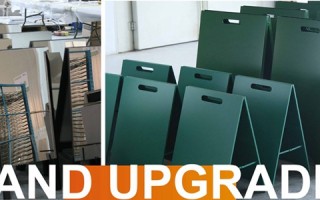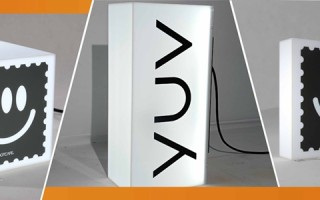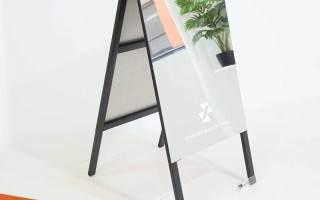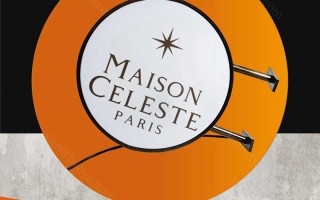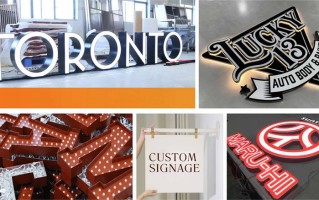
In our line of work, we deal most with various “brands” every day. When customers come to us, their first words are often: “I want to make a brand. ” This sounds simple, but from a picture to a real sign on the wall or at the door, there is a long way to go. Today we will not talk about those empty theories, but will actually go through how a sign "changes" from an idea, and then "stands" firmly where it should be.
You have to decide on the "look" first: Design is the soul
.jpg "从设计到上墙,聊聊标牌制作与安装那些事儿")
Yes, production and installation are the last step, but the beginning of everything is design. Many people think that design is just choosing a font and laying out a layout. In fact, it is much more than that. You must first understand, who is this brand for? Place it indoors or outdoors? Is it hanging on the roof of a building dozens of meters high, or is it placed on a counter within reach? These determine almost all the choices that follow.
A guide sign in a shopping mall must be clear and friendly, and may also have a sense of design to match the environment. ; The first priority of a safety warning sign outside a factory warehouse is to be eye-catching, durable, and weather-resistant. At this time, materials, processes, sizes, and colors must be roughly mapped out during the design stage. We often communicate with customers, and sometimes we have to advise them not just to look good, but to think about reality. If you design a particularly slender artistic word and place it outdoors, problems may arise soon after a strong wind or exposure to the sun or rain. Good design is a combination of artistic sense and engineering sense, and must be "implemented."
There are a variety of materials, choosing the right one is key
After the design is finalized, the next step is to "materialize" it. This comes to the selection of materials, which has the most tricks and is also the most likely to dazzle laymen.
Acrylic (plexiglass) : This is a frequent use for indoor signs. It is transparent, beautiful, can be made into various shapes, and comes in rich colors. It is used on many store logo walls, department cards, and medals. However, it is afraid of scratches and may turn yellow and become brittle when exposed to the sun for a long time outdoors.
Metal (stainless steel, aluminum plate, galvanized plate) : The "handle" of outdoor signage is strong, durable, and has a stable, industrial or high-end temperament. Stainless steel can be used for various effects such as brushed, mirrored, and corroded. ; Aluminum plates are lightweight and suitable for making large characters or sign bodies, but the metal processing process is complicated. Cutting, bending, welding, and polishing require skills at every step.
PVC, Chevron board : It is an economical choice. It is often used in temporary activities, indoor display boards or places where durability is not required. It is easy to carve and light in weight, but the texture is inferior and it is afraid of deformation at high temperatures.
wood, stone : This kind of natural materials are often used in specific style places, such as scenic spots, B&Bs, and high-end clubs. They pursue a unique natural and rustic charm, but they are laborious and costly to maintain.
Selecting materials, to put it bluntly, means finding the best balance between budget, effect, usage environment and lifespan. There is no best, only the most suitable.
Craftsmanship is the process of "waking up" the drawings
Once the material has been selected, how do you make it look like the design drawing? This is the magic of craftsmanship.
print : For graphics and text with complex images, such as maps and color posters, UV printing and screen printing are mostly used. Nowadays, many outdoor printings also use UV printing, which is UV-resistant and can last for many years without fading.
engraving : Whether it is laser engraving (fine, suitable for acrylic and wood) or plasma cutting (suitable for thick metal plates), the outline can be cut out accurately, and the engraved words and graphics have sharp edges and are very textured.
Bending and welding : Making three-dimensional characters and box characters is inseparable from this. After the metal plate is cut, it is made into a character shell through precise bending, and then welded and polished. Finally, it may be electroplated (such as titanium), spray painted or baked.
luminous characters : This is a large category. LED modules must be installed inside. The word casing is usually surrounded by metal. The panel may be an acrylic light-transmitting plate. It involves circuits and wiring. Waterproofing (especially outdoors) is particularly important, otherwise it will become "blind" or short-circuited at night.
Every link requires experienced masters to operate. Sometimes the perfect curves that appear on the computer may have to be fine-tuned due to material tension and process limitations. In this industry, the touch and experience of masters cannot be replaced by machines.
.jpg "从设计到上墙,聊聊标牌制作与安装那些事儿")
Install: The last mile is also the most important mile
After the sign is ready and transported to the site, the real "big test" is installation. If there is a problem with the installation, all the previous efforts may be in vain.
Before installation, site survey is essential. What is the structure of the wall? Concrete, brick, glass or studded drywall? Where is the focus? How to connect the power supply? Are the installation height and angle appropriate? These must be figured out in advance, an installation plan must be formulated, and sometimes coordination with the property management and decoration teams is required.
There are also various installation methods:
Wall installation : The most commonly used method is to choose expansion screws, chemical anchors, welded embedded parts, etc. according to the wall condition and the weight of the sign. The key is to be firm and level.
Installation on site : If there are pedestal signs, pre-embedded piles, etc., make sure the foundation is solid to prevent them from tipping over. Especially when outdoors, wind loads must be taken into consideration.
Hoisting : For hanging tags used at high altitudes indoors, such as shopping mall atriums, the strength and balance of the hanging points are extremely high.
Paste : Some small, lightweight indoor signs will be pasted with strong glue or foam glue, but there are requirements for the cleanliness and material of the wall, so it is not a panacea.
Installation is not only a physical job, but also a technical job. You need to bring various tools such as levels, electric hammers, and welders. When working outdoors at high altitudes, safety regulations are a top priority. Seat belts and guardrails are also indispensable. We are most afraid of encountering the kind of installers who "just do it." If the sign is crooked or the screws are not firmly tightened, it will be a hidden danger in the future. A good installation should be neat, stable, safe, and harmonious with the surrounding environment, as if it is already there.
A few final words
So you see, starting a sign from scratch is not as simple as "making a brand". It is like a small project that requires design, production, and installation. It requires the close cooperation of designers, craftsmen, and installation masters. If any link in the middle is missing, the final effect may be compromised.
As a user or customer, understanding these basic processes is not to get started personally, but to be able to better communicate with the manufacturer, know where your money is spent, and have reasonable expectations for the final effect. For us practitioners, every production and installation is to carry the trust and appearance of the customer on our shoulders. Watching a sign properly placed and starting to fulfill its mission of guidance, identification, and publicity, that sense of accomplishment is probably the most real pleasure in this industry.
Next time you pass by a clear and bright sign, or look up and see the shining LOGO on the roof of the building, you may think that there is such a journey from drawing to reality behind it, and this is what our group of "brand makers" are busy and thinking about day after day.