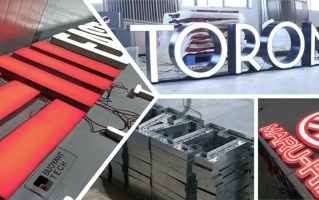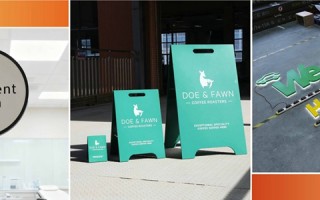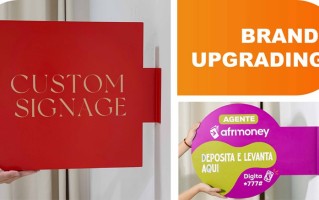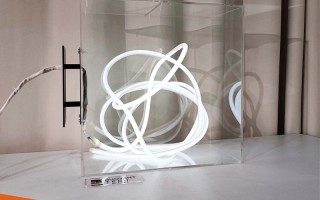
Recently, when passing by a newly opened commercial plaza in the city center, many people would stop and look up at the metal "seed" sculpture, which is nearly five stories high. The streamlined silver surface shines in the sun. If you look carefully, you will find that the name of the design company is embedded on it - it is not a rigid copper sign, but the texture grown by the sculpture itself, which has become part of the logo. Friends took photos and sighed.: “Are even company signs so 'arrogant' now? ”
.jpg "当巨型3D打印雕塑成为城市地标,一家设计公司如何用标牌讲出新故事?")
This is probably what large-scale 3D printing sculpture advertising design companies are doing: They are no longer satisfied with making a sign hanging on the wall, but are trying to "print" the corporate logo, brand spirit, and even a story directly into a city landscape.
From wall to skyline: The dimensional revolution of signage
In the final analysis, traditional signage design is based on two-dimensional thinking. Even if it is three-dimensional characters, it is still considering how to present it better on the wall or column. However, 3D printing technology, especially large or even giant printing, has completely broken this dimensional limitation. The design company's signage suddenly has "volume", can exist independently, can interact with people, and can even carry practical functions.
I visited the founder of a design company that specializes in this. His studio was filled with various models. He picked up a spiraling abstract sculpture, and the hollow in the middle happened to be a variation of the company's LOGO. “You see, the client wanted a logo that represented 'innovation' and 'rise'. If it were just a logo wall, it would be too thin. Now we have made it into an entrance sculpture. It is a logo during the day, and it transmits light at night, becoming the light source and guide for the area. It is first of all a public art, and secondly a sign. ” This shift in thinking is critical - signage changes from "subordinate explanation" to "subject expression".
Technology is no longer a shackle, but a brush
The most fascinating thing about large-scale 3D printing is probably that it greatly releases the imagination of designers. In the past, complex curved surfaces, amazing overhangs, and precise internal hollow structures were expensive or even impossible to realize in the field of traditional sculpture or architecture. As long as the model can be built, there is a chance to be printed.
“In the past, when communicating with customers, the most common thing I heard was, 'Can't this process be done? ’‘It's way over budget'. ”Another designer told me, “Now we often remind clients: Take it easy and let your imagination run wild, but you also have to consider later transportation, installation and maintenance. ” After the technical threshold is lowered, the challenge returns to the design itself.: How to make a giant object not only eye-catching, but also have connotation, dialogue with the environment, and withstand the scrutiny of time?
The “invisible narrative” of materials and craftsmanship”
The charm of these large-scale printed signs is also hidden in the details of the materials and processes. Commonly used materials such as engineering resin, nylon fiberglass composite, or metal powder each have their own "temperaments". The resin can be polished to a warm and jade-like texture, which is suitable for expressing a soft and future brand image. ; Metal printing is full of industrial power, with a cold and precise temperament.
I have seen a case where a technology company used recycled ocean plastic particles as printing raw materials to create a wave-shaped logo sculpture at the company's entrance. The material itself became the most powerful statement of the brand's environmental protection concept. At this time, the sign, material, shape, and text information formed a complete narrative closed loop, which was more direct than any advertising slogan.
.jpg "当巨型3D打印雕塑成为城市地标,一家设计公司如何用标牌讲出新故事?")
More than just a logo: Fusion of function and emotion
A more cutting-edge exploration is to make these large sculpture signs "alive" and carry more functions. The dynamic lighting system is integrated into the structure so that the signs can show different colors and patterns at night, echoing festivals or corporate activities. Or, the bottom of the sculpture is designed as a rest seat, and the hollow part becomes an information display screen. It becomes a node integrating brand display, public art, and community services.
This requires design companies to have cross-border integration capabilities - they must understand not only design and printing, but also structural engineering, lighting design, and even interactive programming. The role of sign designers is evolving into a "comprehensive project planner".
Challenges and Temperature: Between dazzling skills and resonance
This road also has pitfalls. The biggest problem is that it is easy to "show off skills for the sake of showing off skills." If a huge and strange sculpture stands in the square, if it is just abrupt in shape, out of touch with the core of the brand, and incompatible with the surrounding environment, it will only confuse people instead of leaving a deep impression.
Good design should have a warm connection. It requires designers to have a deep understanding of the brand's history, values and target groups. They also need to examine the context, flow of people and sight lines of the land like an urban planner. The successful "seed" sculpture moved people because the square where it is located is called "Seed Square". The form of the sculpture echoes the theme of regional renewal. The clever integration of the company's logo is not stiff at all, as if it grows naturally here.
The future is here: Signage as the starting point for the brand experience
Looking back, the large-scale 3D printing sculpture brings far more than a technological upgrade to the signage field of advertising design companies. It is more like a statement.: The brand expression of an enterprise can be more grand, more three-dimensional, and more integrated into public life.
The company logo of the future may no longer be a line of words you look for on a building after arriving at your destination. It may break into your line of sight as a highly contagious artistic form before you enter the park, making you first curious and expectant about the space you are about to visit and the company behind it. It has changed from the "end" of information to the "starting point" of brand experience.
In this process, the designer’s happiness is probably just like what the founder said: “Watching the lines and surfaces in your computer gradually turn into a giant thing, stand on the land, and become part of the urban landscape. Even years later, people will point to it and tell stories. This kind of satisfaction of creating an entity is something that no graphic design can give. ”
Next time you see those amazing giant artistic signs, you might as well stop for a while. It is not just the name of a company, but more likely a story about technology, art, branding and urban dreams. It is being printed into our reality in the most solid way, and the group of designers behind it are using this almost "clumsy" physical creation to redefine for us what "sense of presence" is in the digital age.