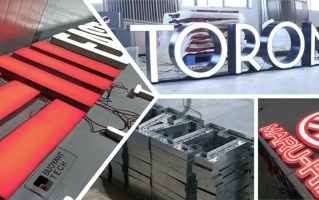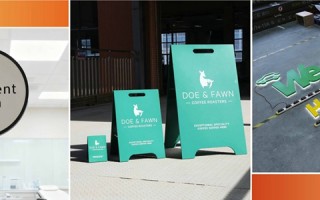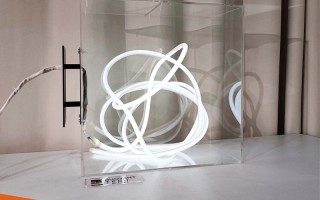
Recently, I was chatting with colleagues backstage and found that many people are particularly interested in the role of "signage 3D designer". They feel that this job is both cool and professional. They deal with three-dimensional models and lighting materials every day, and the renderings produced are much more "sounding" than graphic design. Indeed, with the increasing requirements for signage systems in commercial spaces, urban landscapes, and large venues, a 3D design that can accurately present three-dimensional effects, material textures, and even environmental atmosphere has almost become a standard feature for high-end signage project proposals.
.jpg "想成为一名标识标牌3D设计师?别光看教程,这些接地气的门道你得懂")
But if you think that you can just open a 3D software, build a model, and paste a picture, then you may be thinking a little too simply. Today we will not talk about the basic operations of the software (there are a lot of online tutorials), but will talk about something more "down-to-earth", how to "practice" a qualified 3D designer of logos and signs.
You have to be a "logo designer" first, and then a "3D presenter".
This is the core point and the most easily overlooked. Many novices tend to be addicted to software skills, building the model to fly and rendering it like a photo. But looking back, the proportion of the sign itself is out of balance, the information level is confusing, or the installation structure is simply unreasonable. This puts the cart before the horse.
You must first understand the fundamental principles of logo design: The clarity of information transmission, the effectiveness of visual identification, the coordination with the environment (people, buildings, space), and the terrible process achievability. An excellent signage 3D design is essentially a three-dimensional space that rigorously scrutinizes and verifies the feasibility, aesthetics and final effect of a signage scheme. You need to look at it more often. Study more excellent logo cases and understand the characteristics of different materials (stainless steel, acrylic, aluminum plates, luminous characters), the details of different processes (bending, welding, silk screen printing, baking paint), and even the structural changes brought about by installation methods (hoisting, wall hanging, floor-standing). With these "materials" in mind, your 3D model will not be an empty shell.
The software is the pen, but the “material library” and “sense of space” in your mind are the ink.
Nowadays, mainstream 3D software, such as 3ds Max, C4D, SketchUp, Rhino, including renderers V-Ray, Corona, and Keyshot, you can learn any of them. The key is to master one or two and form your own efficient workflow. But there are two things that are more important than software operation.:
.jpg "想成为一名标识标牌3D设计师?别光看教程,这些接地气的门道你得懂")
One is The “feel” of materials and light and shadow” , you have to have a keen observation of materials in the real world. Does brushed stainless steel reflect the same on a cloudy day as under strong light? How soft are the “halo” edges of acrylic translucent characters? Does the metallic paint have a little orange peel or is it absolutely smooth? These subtle differences determine whether your rendering is "real and credible" or "plastic-like". Don't go shopping in vain, touch and look at it more, take pictures with your mobile phone, and build your own material reference library.
The second is “Intuition of Space and Proportion”” , signage is not an isolated work of art. It grows on the wall, hangs in the air, or stands on the ground. In your 3D scene, you need reasonable reference objects (people, cars, trees, furniture) to imply scale, and real ambient light (skylight, indoor lighting) to create the atmosphere. A logo looks good on a pure white background, but when placed in the actual scene renderings, it may appear small, abrupt, or "eaten" away. To cultivate this sense of spatial coordination, you need to look at architectural photography, interior design drawings, and even play some high-definition games, which are all helpful.
Communication is more important than you think.
3D designers are often considered to be behind-the-scenes technical positions, but in fact, you may be a key link connecting customers, graphic designers, structural engineers and production plants. Customers say "be a little taller", how do you use three-dimensional effects to materialize? The graphic designer has given a beautiful graphic, but will it deform after being stretched into a three-dimensional structure? When the factory master looks at your model, can he clearly know how each component is assembled and what process is used?
Your model must not only be "good-looking" but also "easy to understand", with clear layering and naming conventions. When necessary, you must be able to produce simple exploded structural diagrams, dimension diagrams, and even animations to demonstrate the assembly logic. Learn to use renderings to guide customers to understand the final effect, and use technical detail diagrams to help back-end production avoid pitfalls. This can save you countless late nights of back-and-forth revisions.
Stay passionate and embrace imperfection.
This line of work is sometimes very frustrating. A model is adjusted repeatedly and the rendering takes an entire night. Party A may have to overthrow it if it “doesn’t feel right”. Without a real love for three-dimensional modeling and light and shadow texture, it is difficult to persevere. Don’t pursue every picture as flawless as a movie poster. Some quick renderings used for internal discussions can illustrate the problem. Efficiency is the priority. In real projects, it is often necessary to find the best balance between effect, efficiency and realizability within a limited time.
Becoming an excellent signage 3D designer is a step-by-step process. You need to practice the software, but you also need to practice your vision and thinking. It starts from understanding the logo itself, to thoroughly understanding the material process, to mastering the light and shadow of the space, and finally being able to communicate and collaborate smoothly. Every step counts. This work has both the coldness of technical rationality and the warmth of creating beauty. After doing it for a long time, you will be able to find your own sense of accomplishment in it. Take your time and start with a simple guideboard modeling simulation.