Recently, the company's business has been expanding and we plan to recruit a full-time 3D logo designer. The recruitment notice has been posted for half a month, and I have received a basket of resumes and several rounds of interviews. However, there are not many suitable candidates. Among us old editors and project leaders, this matter is almost a thing of the past. The "Tucao Conference" has become a fixed topic. Today I won't talk about technical stuff at all, but just chat with everyone. In our "signage and signage" industry, which seems to be segmented but actually has many requirements, how difficult it is to recruit the right 3D designer, and what kind of person we really want in our hearts.
.jpg "招个靠谱的3D标识设计师,怎么就这么难?聊聊我们踩过的坑和真心话")
First of all, I have to say that this position is really not a pure "art" job. You might say that a 3D designer is just fine with the software, cool models, and stunning renderings. Hey, we thought the same way at first, but ended up interviewing a few whose portfolios could be called "Hollywood blockbuster trailers." When we asked specific questions, we became timid.
I asked him: “If a customer wants to erect a 5-meter-high hollow metal sign in an outdoor plaza, what points should you pay attention to in terms of the structure of your 3D model, taking into account wind resistance and internal structural support? How to reserve reasonable installation and welding space for the internal steel frame keels in the model without affecting the aesthetic appearance? ” The young man opposite, whose works were full of sci-fi spaceships and game characters, suddenly looked a little wandering and started talking about material subdivision and global illumination... This was wrong.
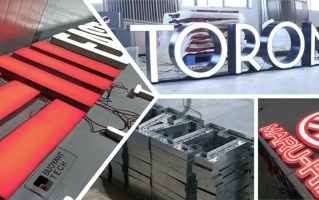
What we need, first of all, is a “knowledgeable art” , he has to understand that the cool 3D model he built will not live on the screen in the future, but will "come out" from the computer and become real metal, acrylic, stainless steel, and luminous characters. This means that he must Material technology, production process, installation conditions Have a minimum understanding.
For an excellent 3D logo design, beauty is just the ticket. More importantly, it must be "groundable". The chamfering angle of the model may determine whether the stainless steel plate can be bent. ; An overly elegant surface may cause the sheet metal master to scold her and cause the cost to soar. ; No matter how dreamy the lighting effects are, we still have to consider the arrangement density and heat dissipation issues of the LED modules in reality. Some of this knowledge can be learned from the masters in our production department. However, if the designer does not have this string in his mind at all, the resulting design will easily be a "castle in the air" that looks good but is not easy to use, and production and installation can be frustrating.
We have been stuck with the template for a long time! The portfolios of many job seekers look like the "e-commerce product display style" or "conceptual art style" that are popular online. The glass material is glowing with rainbow light, and the scene resembles a mobile phone conference, but it is the same and lacks thinking about the uniqueness of the "logo" itself. The logo is the eye of the environment and the silent spokesperson of the brand. It needs to talk to the architectural space and fit in with the brand culture. The designers we need must have Creative thinking ability from scratch , can digest the brand VI, space drawings, and environmental photos provided by the customer, and then extract the core elements, use three-dimensional language to transform and innovate, instead of simply pasting a ready-made cool model with the customer's logo.
.jpg "招个靠谱的3D标识设计师,怎么就这么难?聊聊我们踩过的坑和真心话")
Communication and understanding skills may be more important than software operation. Logo design is not an artist's personal creation, it is a service link. Designers need to be able to understand the vague needs of customers (sometimes customers who don't know much about design) - "I want it to be more high-end", "it doesn't feel smart enough", "can it be more grand"? He has to translate these abstract words into specific shapes, materials, colors and lighting solutions. He also has to be able to communicate smoothly with our structural engineers and production project managers, clearly express design intentions in drawings and model language, and understand the process limitations proposed by the production side. If there is a wall in between, the project will be stumbling forward.
There is another very important point, which is that Obsessive about details , logos, especially high-end customized logos, often require attention to detail. The processing of corners, the hiding of seams, the uniformity of light transmission of luminous characters, the balance between night and day effects... These details must be carefully considered in the three-dimensional design stage and presented to the customer as realistically as possible through renderings. A designer who is careless about details can easily lay countless pitfalls for subsequent links.
After going around in such a big circle, what does our ideal "him/her" look like? This is probably a portrait:
You have to be truly passionate about "physical" things. You are not satisfied with the perfect rendering on the screen. You also enjoy the sense of accomplishment when the design becomes a real thing and stands on the street corner or hung in the lobby. Software (such as 3ds Max, C4D, Rhino, SU, etc.) are basic skills, but more important than software is the "three-dimensional dictionary" that holds materials, processes and costs in your head. You must have a solid aesthetic foundation, but you must also be able to make smart compromises and re-creations for the sake of "realizability". You must be a good "translator" and "listener", able to flexibly switch channels between customers, within the company, and the producer. It is best to have a bit of obsessive-compulsive disorder, and "care about every line and every aspect of the model."
The difficulty in recruiting people actually reflects the scarcity of professional talents in this niche field. Many excellent 3D designers have gone to the gaming, film and television, and advertising industries, specializing in "physical sign manufacturing". They really need more industrial experience and cross-border knowledge. For content developers and potential employers like us, in addition to casting a wide net, we are also more willing to cultivate those "semi-finished products" with potential, attitude, and willingness to learn.
If you happen to be such a person, or you know such a friend, and you feel that these "pain points" we are nagging about are your "itch points", then don't hesitate. We don't have unrealistic ideas here, but we have a solid stage to turn creativity from virtual to reality. ; There are no repetitive and boring template applications, but there are various practical projects that challenge the combination of craftsmanship and creativity. Together, we can create good things that are tangible, visible, and can stand in the wind and rain for many years. Isn't this in itself a cool thing?
Of course, recruitment is still going on, and the complaints will not stop. This is our real and somewhat trivial daily life. I hope that next time we talk about this topic, we have found the "right person."