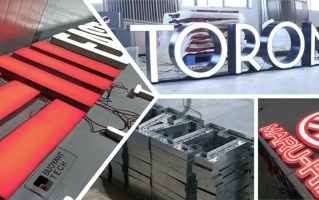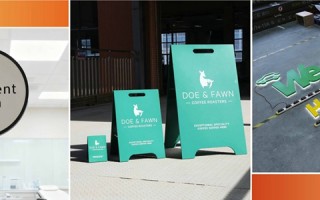
Hey, friends who make signs and signage, as well as the fathers of Party A who are having a headache with the project, today we are not going to talk about those vain design theories or advanced craftsmanship, but sit down and actually talk about something that may be regarded as a "flower shelf" by many people.—— 3D renderings of logo signage design .
I know, many people may be murmuring in their hearts: “Isn't it just a rendering? It just looks good. The final result is another matter. ” or think: “This thing is just for customers to see and render it beautifully so that they can sign contracts. ” If you think so, then today’s article may bring you a different perspective. I have to say that in the signage industry, a high-quality 3D rendering is far more than a “facade”. It is more like a “preview script” and “pitfall guide” for a project.
.jpg "别小看3D效果图,它可能是你标识标牌项目成败的关键")
Let’s talk about our most common pain points first. You must have encountered this situation.: The floor plan of the design draft looks very beautiful, with smooth lines and high-end colors. Everyone hit it off immediately during the meeting and agreed that there was no problem. What is the result? When the actual object is made and installed on the wall, it looks awkward, or the proportions are out of proportion. It looks small and exquisite in the renderings, but in reality it looks bulky and abrupt. ; Either the material texture is completely different from what I imagined. The renderings show a matte high-grade gray, but the real thing has a cheap plastic feel. ; What is even more troublesome is the structural problem. A certain corner cannot be turned at all in the actual space, or when the lights are turned on, unexpected and ugly shadows appear.
It is difficult to fully expose these problems by relying solely on graphic design drawings and head-to-head fantasies, and a carefully crafted 3D rendering can play a huge role at this time. It is no longer a simple "effect display", but a Multi-dimensional verification tool .
.jpg "别小看3D效果图,它可能是你标识标牌项目成败的关键")
First, it is the “translator” of space. Signage is never an isolated work of art. It must grow in a specific environment, such as the atrium of a shopping mall, the lobby of an office building, the entrance to a park, a store on a street corner... Each space has its own scale, light, color and atmosphere. What 3D renderings can do is to accurately "place" your design plan into this real or simulated environment. You can see what the sign looks like under natural light in the morning, and can also simulate the effect of turning on the spotlights in the evening. ; You can judge whether it is clearly legible 10 meters away, and you can also check whether the details can withstand scrutiny when you get closer. This kind of deduction based on real space can avoid too many "paper talk" mistakes. What you think is a big word may "disappear in an instant" against the background of an open square.” ; Colors that you think are harmonious may "fight" with the building's facade. These are clearly visible in the 3D scene.
Second, it is a “dry stage” for craftsmanship. For our producers, 3D renderings are a powerful tool for internal communication and production guidance. How can the internal structure support a complex special-shaped logo? How to connect different materials (such as metal, acrylic, LED light strips)? How to arrange the light sources of luminous characters so that they are uniform and opaque? These issues must be taken into consideration during the 3D modeling process. When building the model, the modeler has actually gone through the production process in his mind. A responsible 3D drawing will even disassemble an exploded view of the structure, allowing the master craftsmen in the production department to understand the stacking relationship, installation sequence and possible difficulties at a glance. This can greatly reduce the cost of trial and error in the production process, and avoid having to start over after discovering that "this road is not working" halfway through.
.jpg "别小看3D效果图,它可能是你标识标牌项目成败的关键")
Third, it is a “common language” for communicating with customers. What are you most afraid of when communicating with clients about design plans? What people are most afraid of is "I thought you understood, you thought I wanted that". The text description is pale, the floor plan is abstract, and everyone's imagination is different. However, a realistic 3D rendering can almost eliminate this cognitive bias. Customers can intuitively see the near-real appearance of the future finished product, including day and night effects and shapes from different angles, and the discussion becomes concrete.: “Is this corner too sharp? ”“Try dimming this blue by 5%? ”“Will the lights be too dazzling at night? ”All modification opinions are based on a visual and unified benchmark, which greatly improves communication efficiency and reduces disputes caused by "not what I imagined" in the later period. To put it bluntly, it makes decision-making more practical and allows customers to spend every penny clearly.
I'm not saying that all 3D renderings have this effect. There are indeed "fake empty" renderings on the market that only pursue "coolness", are divorced from reality, have material distortion, and exaggerate proportions. Apart from fooling laymen, such images are of no benefit to the project itself and may even mislead decision-making. Truly valuable 3D renderings must have solid work behind them.: Accurate on-site dimensional data, a deep understanding of materials and processes, research on the light environment, and a heart that is responsible for the final implementation of the project.
Next time you start a signage project, whether as a design producer or a demander, please re-examine the "3D renderings" link. Don't regard it as just a dispensable "gift" or "packaging", but as an integral part of the project process. Crucial decision-making nodes and risk control points , spending a little more time and budget on high-quality 3D visualization in the early stage may save you several times the cost of modification, redoing and even customer claims in the later stage.
After all, signage is something made in the real world, and 3D renderings are the closest to real "rehearsal" we can do for it in the virtual world. Once the rehearsal is complete, don't panic when you go on stage (landing). In this era that pays more and more attention to experience and efficiency, making good use of the technology of 3D renderings may be the key to stand out from your competitors. After all, who doesn't want to see certain and beautiful results before taking action? This deal is a bargain.