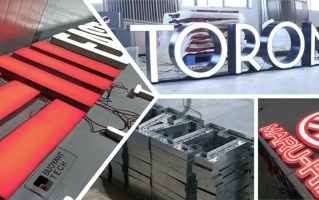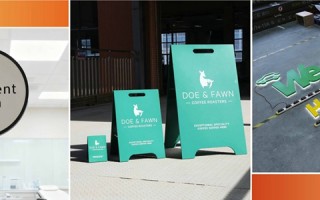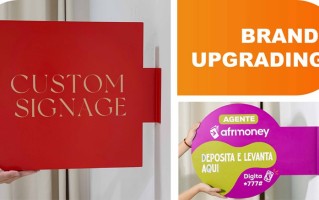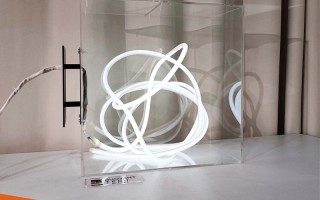
Every time you show a signage design to a client, do you always feel like something is missing? Yes, it is the kind of three-dimensional, real, and "wow" feeling. A flat design draft, no matter how exquisitely drawn and beautiful the colors are, may only be exchanged for a sentence when it reaches the client.: “Well, not bad. ”But if you can "snap" that floor plan into a 3D rendering that can be rotated 360 degrees, with light and shadow, and texture, the scene will be absolutely different. Customers can immediately imagine what it looks like standing there, communication efficiency will increase, and the probability of closing a deal will be much greater.
Today we are going to talk about how to bring the graphic design drawings of logos and signboards in our hands to life and create exciting 3D effects. This is not magic, but it does require some methods and suitable tools.
.jpg "平面设计图秒变3D效果图?标识标牌这样玩,客户一眼就爱上!")
Don’t get confused when you hear 3D, thinking that you have to be a professional to do it. Many software nowadays are actually quite friendly to novices. You can start with some modeling software that is relatively easy to use. Many of them provide basic three-dimensional tools. You import your graphic design drawing-that is, the AI or CDR file-and use it as a "script" or "texture". Here comes the key step.: According to the design drawing, place the signage The outline is "pulled" up .
What does it mean? For example, if you are designing a special-shaped corporate image wall, the plan will be a beautiful graphic with a logo. In the 3D software, you can follow that graphic and use the extrusion, push and pull functions to give it a thickness. If it is thinner, it may be the metal characters of the spiritual fortress, if it is thicker, it may be a three-dimensional wall carved from stone. In this step, the plane is turned into a "blank" with volume.
.jpg "平面设计图秒变3D效果图?标识标牌这样玩,客户一眼就爱上!")
Just the shape is not enough, it is the plaster model, and then it is the soul that makes the sign "alive": Materials and light and shadow , this is where the most effort is put to the test and where the effect is most effective. What materials are used for the signs you design? Is it gleaming brushed stainless steel, or heavy and steady rusted iron plate? Is it warm acrylic or rustic wood grain? In the software, you have to find the corresponding material ball, or adjust it yourself, adjust the parameters such as color, reflectivity, and roughness, and then "paste" the patterns and text on your graphic design to the surface of the three-dimensional model like wallpaper. At this time, you can initially see how it "wears" clothes.
But it’s not even that interesting, right? Because there is light in the real world, it must be Lighting ! Simulate the lighting of its future installation environment. Is it placed in an indoor lobby with bright downlights shining from top to bottom? Or place it outdoors to receive natural sunlight? Different light angles and intensities will give signs a completely different texture. Stainless steel will have sharp highlights under strong light, and matte paint will show delicate textures under side light. Don’t ignore shadows, as real shadows can make objects "stand" firmly on the ground instead of floating.
Find a good angle, Render out the image , this angle is best able to display the front and side of the sign at the same time, reflecting its three-dimensional sense. The rendered image has clear details, natural light and shadow, and it is best to have some environmental background (such as a simple grass, sky or indoor corner) to make it more scene-like.
In this way, what you hand over to the customer is no longer a cold drawing, but a "finished product preview" that is almost within reach. He can clearly see the turning of the metal, the reflection of the light, and even the luminous effect at night (if you do night scene rendering). This not only greatly reduces misunderstandings in communication - "Oh, you want this three-dimensional degree" - but also directly stimulates the customer's desire to own it.
To be honest, in this era of visual dominance, taking the time to master this skill, or finding a reliable partner to help you achieve this step, is definitely a tool to add points to our signage design and production business. It makes creativity more intuitive and makes persuasion easier. Next time you make a plan, you might as well try it and inject 3D vitality into your graphic design to see if the customer's reaction will be surprising. After all, everyone is more willing to pay for something that is visible and tangible, don't you think?
.jpg "平面设计图秒变3D效果图?标识标牌这样玩,客户一眼就爱上!")