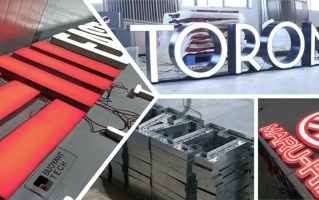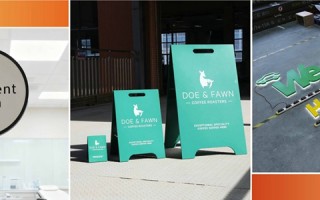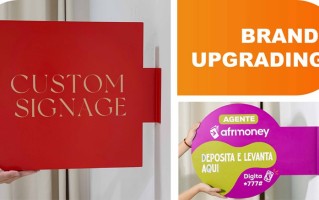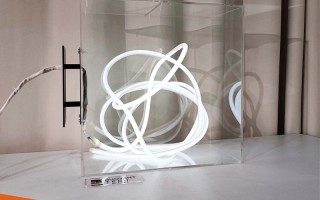
Recently I was chatting with some friends who own sign shops, and everyone was thinking about one thing.: Do you want to get a 3D printer? Nowadays, customer tastes are becoming more and more sophisticated. The same kind of flat acrylic characters and metal characters are a bit overwhelming. The demand for three-dimensional shapes, special-shaped structures, retro reliefs, and even personalized logos with a touch of art has increased visibly with the naked eye. Do it by yourself, which is low-efficiency and high-cost. ; Outsourcing, communication is troublesome, and the price cannot be controlled, so my eyes naturally turned to the beautiful-sounding solution of "3D universal printer".
Especially the words "factory direct sales" are very attractive to businessmen like us who are budget-conscious and pursue cost-effectiveness. Eliminating the middlemen and getting goods directly from the source will definitely make the price better, and the after-sales service should also be more direct in theory. But to be honest, I have been in this industry for many years and have been in contact with many manufacturers. I have found that the "factory direct sales" is actually quite deep. Today I will talk to you about the tricks here and help you avoid pitfalls.
Pour some cold water on it first: “"One-size-fits-all" can be a wonderful trap
.jpg "想找靠谱的标牌3D万能打印机厂家直销?先看完这篇掏心窝子的分享")
First of all, let’s be clear. Many advertised “3D universal printers” on the market, especially those targeting the signage industry, often focus on being “can print anything”, with metallic textures, wood grain effects, full colors, transparent parts... Looking at the promotional video, it’s quite dazzling, but we have to understand that the current 3D printing technology does not have a true “one-size-fits-all” “artifact” for all signage materials and effects.
The so-called "universal" refers to a device that can achieve various functions by replacing the print head and adjusting the material. many types For signage production, for example, it can be printed with PLA/ABS for internal structures or simple signs, composite materials to imitate the appearance of metal or stone, or photosensitive resin for fine relief details, but it is difficult to do both perfectly at the same time. High-strength outdoor weather resistance, extremely fine surface texture, large-format efficient molding, and low cost , when selling directly from the manufacturer, the salesperson may exaggerate its functions, so you have to ask clearly.:
.jpg "想找靠谱的标牌3D万能打印机厂家直销?先看完这篇掏心窝子的分享")
“What materials does "universal" refer to specifically? Will it only be able to use a few basic plastic wires, or will it support real composite materials (such as wires mixed with metal/wood powder) and high-performance resins? What is the price and supply stability of these "special materials"? Don't forget that the machine is cheap, and the materials are "bound" and expensive.
Molding size and accuracy are hard indicators. Signs come in all sizes, what are your mainstream business sizes? Is the maximum print size mentioned by the manufacturer the effective build size? How is the edge accuracy? If I type a 50cm high three-dimensional character, will the details be blurred? It’s best to have physical samples to look at, or ask them to provide videos of printed test pieces.
Is post-processing troublesome? Does the typed thing require a lot of sanding, polishing, and coloring before it can be seen by anyone? If necessary, the so-called "efficiency improvement" will have to be discounted, and labor costs will go up again. Some technologies (such as SLS powder sintering) are very troublesome to clean up after printing, and some (such as FDM fused deposition) have obvious step patterns. Ask the manufacturer whether the post-processing process and equipment are compatible.
Factory direct sales, where is the "directness"? this is the key
It is very important to find the real source manufacturer, rather than an agent or trading company with a "manufacturer" label, but how to judge?
.jpg "想找靠谱的标牌3D万能打印机厂家直销?先看完这篇掏心窝子的分享")
Look at the actual production scene and R&D capabilities. Do you dare to open a live video workshop for you? Do you have your own technical team, or is it purely assembly and OEM? Signage printing has special features, such as large format, multi-material adaptation, special slicing software optimization, etc. Only manufacturers with R&D capabilities can work with you to solve strange problems in actual production, instead of asking you to "wait for a reply from the headquarters" whenever a problem arises.
Are prices transparent and reasonable? Direct selling prices should have advantages, but be wary if they are ridiculously low. It may be that the core components (such as lasers, nozzles, and motherboards) are low-end or second-hand refurbished, or the workmanship is rough. A detailed configuration list and parts brand list are the confidence of a reliable manufacturer. Don’t forget to ask about subsequent maintenance costs (such as the cost of replacing nozzles and lasers).
Is the after-sales support really "direct"? This is the core value of direct selling! If there is a problem with the machine, should I contact the engineer directly or transfer to customer service and wait in line? What is the response time? Can remote diagnosis and guidance be provided? Are there permanent technical service personnel in your area or nearby cities? Warranty terms (which parts are covered and for how long) must be written clearly in black and white. For those "direct sales" where you can't find someone after selling the machine, or the after-sales phone number is always busy, it is better to find a reliable local dealer.
Some down-to-earth advice for friends who want to buy it
Think clearly about your main business and then match it. If you are mainly doing large-scale outdoor engineering signs, you may need to focus on technology that can print high-strength nylon materials or large-size metal printing (such equipment is usually very expensive). If you are mainly doing indoor creative signs, store logos, medals and trophies, then a DLP/LCD light-curing printer with good accuracy or a high-quality FDM printer may be more affordable. There is no best, only the most suitable for your business flow.
“Proofing” is the touchstone. Don't just look at the promotional pictures, go directly to a few "direct sales manufacturers" you like, provide you with a typical design file (preferably with some complex curves and details), and let them make free or paid proofs. After receiving the actual product, look at it carefully.: Are the layers obvious? Are the details clear? How strong is it? How does the surface feel? How is the color reproduction (if it is a color print)? Compare the real thing and judge the difference.
Calculate the overall account. Don’t just calculate the price of the machine. Consider the cost of the equipment, floor space, cost of consumables (for different materials), the manpower and material resources required for post-processing, the expected depreciation and maintenance costs of the equipment, and the business premium and efficiency improvement it can bring to you. Comprehensive calculations include the return on investment cycle. If a machine can pay back its investment within a year through new business or savings in outsourcing costs, it is worth considering.
Be wary of “lowest prices on the Internet” and “over-promise”. It is an iron rule that you get what you pay for in industrial equipment. Those who promise to "can fight anything, never break down, and provide education and know-how" are mostly unreliable. A good manufacturer will objectively tell you the advantages of the equipment, clearly point out its limitations, and give reasonable suggestions for application scenarios.
A few final words:
Using 3D printers is indeed a trend for our sign production. It can open the door to more creative and higher value-added products, but it is not a "just buy it" cash cow. It requires you to relearn some technologies, adjust the production process, and even require you to guide customers to understand the value of 3D printed signs.
Looking for direct sales from manufacturers is about cost-effectiveness and direct technical support, but this process requires you to spend more time, make more comparisons, and ask more "stupid questions." Don't be afraid of trouble. The more detailed the preliminary work is, the smaller the chance of getting into trouble later. Maybe, during the process of repeated communication and proofing, you can become friends with the manufacturer's engineers, and work together to figure out an exclusive process that is more suitable for your store.
In business, tools are important, but the people who use them and their ideas are even more important. I hope these little thoughts can bring you some real help. If you really have a model that you like, but you can't make up your mind, you are welcome to chat again and let's get some advice together!