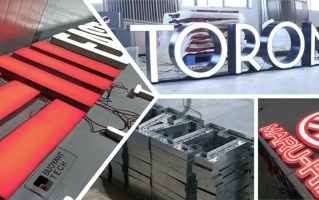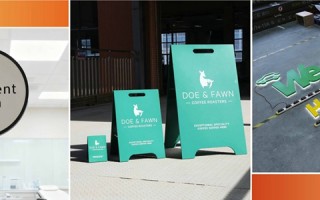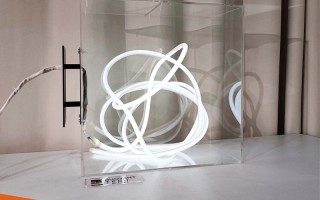
Recently, I was chatting with several friends who own advertising shops, and everyone was complaining about the same problem.: The customer was in a hurry, the design had to be changed frequently, the factory was slow to connect, and in the end, the sign was produced by staying up late and working overtime, and the profit was as thin as a piece of paper, a buddy said with a wry smile.: “Nowadays, when making signs, what matters is not how awesome the design is, but how tough the life is. ”This sounds sad, but it is also a true portrayal of many people in the industry.
But what’s interesting is that there are always people who can find new ways in the same market. Last month I visited a local medium-sized advertising company. They had just received a complete set of store signage orders for a chain restaurant brand, from door to indoor signage. There were more than 40 stores in total. It only took less than a month from design to production. I was curious about how they did it. The person in charge pointed to a web interface on the computer.: “Rely on it, Binghu’s 3D design cloud platform. ”
To be honest, when I first heard the term "3D design cloud platform", what flashed through my mind were those cool but not very down-to-earth concepts. However, after actually using it, I realized that this thing is really not a showpiece, it is more like an "online signage studio", from the early design to the later process docking, it is all connected for you.
.jpg "冰狐Advertising signs
3D设计云平台,让创意活起来的生产力革命")
For example, the most troublesome part of the design process. In the past, when customers said they wanted a "bigger three-dimensional font," the designer had to repeatedly model and render it. Even if they changed the color or thickness, they had to do it all over again. Now on the Ice Fox platform, you can select a basic font and directly drag and adjust the three-dimensional thickness, tilt angle, and material effect. Next to the real-time rendered 3D screen, even the material budget and process difficulty are displayed simultaneously, and the customer is watching and pointing.: “Can this gold be darker? Would it be better to add a light on the back? ”If the designer is a little more casual, the effect will appear immediately, the communication cost will be reduced, the number of revisions will be reduced, and the customer satisfaction will increase.
What makes me think it is more practical is its "process library" function. You know, the signage design is not good enough, it must be made. Some renderings look amazing, but when I ask the factory, either the cost is too high or the process cannot be realized. The Ice Fox platform has built-in data on common materials and processes on the market - how to hollow out metal. How to deal with arcs, key points for bonding multiple layers of acrylic, suggestions for circuit layout of luminous characters... It can even automatically match the production capacity and quotation of the cooperative factory according to the material and effect you choose. The design process avoids pitfalls on the production side in advance. This saves not only time, but also the loss of real money.
I tried using it to make a simple luminous character design. From pulling out the model to adjusting the position of the light trough, and then simulating the effects of different ambient lights, the whole process was like playing a more sophisticated simulation game. The platform also provides a variety of scene templates.: Shopping mall interiors, street entrances, exhibition hall backgrounds... With one click, you can see the preview effect of the sign in the real scene. This is especially useful for projects that require bidding. When reporting on the plan, instead of simply showing a few renderings, you can directly drag and drop the perspective to allow customers to "walk into" the virtual space to see the effect. One customer joked: “This is smoother than the games my kids play. ”
Any tool has an adaptation period. When I first started using it, I felt a little uncomfortable - after all, traditional designers always have a stubborn sense of control over the software. However, after using it two or three times, I felt that it freed up a lot of repetitive work. For example, the structural disassembly diagram of the sign used to be drawn manually for a long time. Now the platform can automatically generate decomposition diagrams of different parts based on the 3D model, mark the dimensions and splicing instructions, and export the files directly to the production end. Even communication errors have been reduced.
.jpg "冰狐Advertising signs
3D设计云平台,让创意活起来的生产力革命")
A friend who works in a factory has been using the Bingfox platform to take orders recently. He said the biggest change is "fewer quarrels." In the past, it was common to argue back and forth with designers. The renderings looked beautiful, but various structures were unreasonable when it came to production. Now, designers use the platform to come up with plans that come with process parameters and structural suggestions. The factory can open the file and can see it clearly at a glance, and can even comment on modifications online. Both parties discuss the same set of models, and the efficiency is much higher.
But having said that, tools are tools after all. The IceFox platform will not create ideas for you, nor can it completely replace people’s experience and judgment of materials and processes, but it is like a thread that strings together the three beads of design, customers, and factories that often fail to roll together. What it lowers is not the threshold of design, but the long and exhausting "conversion cost" between ideas and objects.
The advertising signage industry seems to be about "branding", but in fact it is about "trust". Customers trust you to implement your ideas, factories trust your design, and you trust that the process can be completed on time and with high quality. Platforms like Binghu are using technology to make this trust more visible and controllable.
When I left the advertising company, the person in charge sent me downstairs. There happened to be a new company sign they designed and produced using a platform hanging at the door. It was a metal hollow stacked with an acrylic backlight. When the lights were turned on in the evening, the three-dimensional effect was particularly clear in the twilight. He patted me and said: “You see, I used to think that 3D was about showing off skills, but now I think it is about letting people see what they should be like earlier. ”
Yes, signage is never just a display of information, but also a silent interlocutor in the space. Perhaps a good tool is to make this conversation happen earlier, more accurately, and more vividly.
(over)