Hey, fellow bosses and friends from the marketing department, today we are going to talk about a very common but easily overlooked "face project" - wall advertising signs. You may think, isn't it just a sign on the wall? Why not just find an advertising company to do it? But to be honest, I have seen too many examples of spending money but "ruining" a prime location. A wall, especially a wall facing the street with a lot of traffic, is your salesperson who does not rest 24 hours a day. Whether this "salesperson" is sloppy and slurred in speech, or energetic and unforgettable, it all depends on whether you are careful in the design.
We have to understand that wall advertising signs are completely different from the flyers in your hands and the information you read on your mobile phone. They are static and part of the environment, and the audience often sees them while they are moving (such as driving or walking), which determines the core principles of its design.: Instantly conveyed, powerfully eye-catching , don’t think about piling up the company profile, product list, and contact information. No one will stop and read it carefully. It feels like it is impossible for people to read the short composition on the road sign on the highway.
.jpg "墙面Advertising signs
设计,别让好位置,毁在糟糕的设计上!")
So what exactly should be done? I have summarized some down-to-earth ideas. Please listen and see if this is true.
.jpg "墙面Advertising signs
设计,别让好位置,毁在糟糕的设计上!")
The first move: The characters are big! Simple picture! Sex is about to jump! This is an iron rule. The font must be large enough and clear enough to be recognized from a distance. Don’t use those fancy word arts. Use honest, practical sans-serif fonts with thick strokes. The safest way is to use graphics and pictures that are extremely concise. It is best to use a core visual symbol or product outline. In terms of color, dare to contrast. If the background wall is dark, use bright white or bright yellow for your words. ; If the background is a light-colored or cluttered environment, use a dark or highly saturated solid color block to press it on. This has only one purpose.: Is it like this to "jump" out in a complex environmental background? Think of those successful gas station signs or fast food restaurant logos?
.jpg "墙面Advertising signs
设计,别让好位置,毁在糟糕的设计上!")
The second move: Reduce the content and clearly state "who I am and what I sell" in one sentence. Your brand name and core business (or main product) are the absolute protagonists, such as "XX Auto Repair", "Fresh Fruit Tea", and "Community Canteen". These information must be captured at the first sight. As for the carefully polished slogan, if it is not short enough and not explosive enough, you would rather not put it. If it is put up, it must be of the level of "Afraid of getting angry, drink XXX". The most effective text combination on wall advertising is: Big brand name + core business/product icon + a short slogan + contact number (if necessary) , enough, really.
The third move: Find out the "temper" of the wall and tailor it accordingly. Before designing, you must go to the site to see the wall. How big is it? What material is it (cement, ceramic tiles, glass curtain wall)? What is the color of the surrounding environment? How does the light change at different times of the day? Are there any obstructions (e.g. trees, power lines)? These will greatly affect the final effect. An old red brick wall may be suitable for retro-style iron cutouts. ; A smooth white tile wall may be more suitable for brightly colored acrylic three-dimensional characters. Do not use a "universal template" everywhere, as the effect will definitely be greatly reduced. Use the characteristics of the wall itself (such as cracks and turning structures) to create creative integration, which can work wonders.
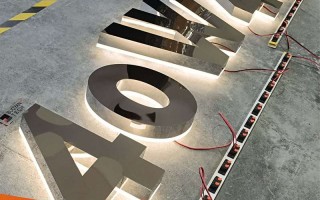
The fourth move: For craftsmanship and materials, the more expensive the better, but the more “right” the better. The design is beautiful, but it has to be implemented in the end. Commonly used wall signage techniques include: Inkjet printing (suitable for short-term, large flat surfaces), UV printing (delicate picture, suitable for complex patterns), acrylic three-dimensional characters (textured, showing class), metal characters (durable, strong business sense), neon lights (invincible at night), etc. When choosing, you must combine the budget, expected service life, installation environment and the most important thing - the brand temperament you want to convey. For a workshop selling handmade pastries, using cold stainless steel luminous characters may not be right. ; For a technology company, using cartoon spray-painted cloth would seem like child's play. By the way, the installation stability and subsequent maintenance (such as light bulb replacement, wiping and cleaning) must also be considered in advance. Don't let it become dilapidated within two years of installation, which will become negative advertising.
In the final analysis, wall advertising signage design is a game with space and the attention of passers-by. It does not require an inscrutable sense of art, but it requires strong strategic thinking and empathy. Standing from the perspective of passers-by, think about what information they are willing to receive, and don’t think about it anymore. Your precious wall can be used as a simple information notice board. Put some thought into it and let it speak for you, and it can catch people as soon as you speak. After all, in this era of scarce attention, every point that can be actively exposed is worthy of being taken seriously, don't you think?