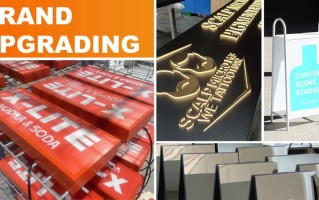
Recently, the studio took on an interesting job, making an acrylic sign for a newly opened independent coffee shop. The client was a girl born in the 1990s, with wild ideas and only one request.: “Be special, but don't be too pushy. ”Yes, this is probably the most troublesome requirement. Today I will talk about the whole process from the design drawing to the finished product, including the details of "rollover" and "rescue". If you are also thinking about acrylic signage design, these experiences may help you avoid detours.
first step: Communication is more important than drawing
.jpg "亚克力工作室标牌设计图,从灵感到成品的折腾全记录")
Many people think that design is just about immersing yourself in drawing. In fact, they are completely wrong. If the early communication is not in place, all the subsequent efforts will be in vain. I chatted with the coffee shop owner three times, once in the rough room they were still renovating, once in the noisy milk tea shop next door, and the last time was in our studio. Why did he travel to so many places? Just to feel the "vibe" she wanted.
She didn't like the cold metallic feel of the industrial style, nor did she want the heavyness of vintage wood. She mentioned a word - "transparent warmth". This word is quite mysterious, but after chatting for more, I found that she was referring to the luster and softness of acrylic, which has a light and warm effect, especially under the light. We looked through a lot of reference pictures, from Japanese niche cafes to Nordic minimalist design, and slowly settled on the direction.: Double-layered light beige acrylic, with thin lines in the middle to outline the abstract outline of coffee beans, and the font should have a rounded handwriting feel.
Step 2: “Talking on paper” and “beating in reality” on design drawings”
Now that the direction is set, let’s start drawing design drawings. Here’s the key.: Acrylic design drawings and final product are two different things , you must take into account material characteristics, process limitations, and installation environment.
The initial renderings we made using software were very beautiful, with gradient tones and stunning light and shadow. But once we communicated with the production factory, problems arose.:
.jpg "亚克力工作室标牌设计图,从灵感到成品的折腾全记录")
color : The "light beige" on the computer may have five or six subtle differences in the acrylic sheet samples. We selected the three closest ones, made samples, and looked at them under actual light in a coffee shop (natural light, warm light) before finally settling on an off-white color that is grayer because it shows more texture under warm light.
thickness and structure : I want to make a double layer stack with hollow lines in the middle. The lines on the design are very thin, but the factory master called me directly.: “This line is less than 3 mm, and the engraving knife is prone to deviation. Moreover, after the acrylic edge is polished, it will appear thinner visually and may appear stingy. ”Yes, change it! Thicken the lines and adjust the spacing between the double-layer panels to make the shadow levels more obvious.
Fixed method : How do you hang this thing on the wall? The customer didn't want to see obvious screws, so we "hidden" a slot-type backplate structure on the back of the design drawing and fixed it with invisible acrylic brackets. This part is just a few simple dotted lines on the design drawing, but it is the key to the structure.
Don’t just focus on the design drawings that look good, go through several rounds of discussions with the producers. Our design drawings went through eight revisions, and most of the time was spent adjusting these “inconspicuous” details.
Step 3: Proofing - a "pit that must be stepped on"”
Once the design is finalized, don’t just make a big deal. Proofing is the only criterion for testing truth , we made two 1:3 samples, and sure enough, there was a problem with the first sample.: After the two layers were laminated, because the glue used was not right, the edges were a little white, and there were flaws when exposed to light. After the handwriting was engraved, it looked thinner than expected.
For the second sample, we changed the bonding scheme and used shadowless glue combined with UV curing. The edge problem was solved and the font was also adjusted. It was not a simple engraving, but a slight "bevel engraving" on the back. In this way, the font is flat when viewed from the front, but when the light shines from the side, there will be a concave three-dimensional shadow, and the texture suddenly comes up. This little trick was suggested by the factory master and cannot be seen on the design drawing.
The money for proofing is absolutely not to be saved. It allows you to actually touch, see, and even "drop" (test the strength) your design.
.jpg "亚克力工作室标牌设计图,从灵感到成品的折腾全记录")
Step 4: Production and installation – the final touches
In the mass production stage, designers cannot just be hands-off shopkeepers. We went to the factory and focused on two things.: Selection of boards and processing after engraving .
Acrylic sheets of the same batch number may also have very slight color differences or bubbles. We personally looked at them one by one under the light box and used the ones with the most uniform colors for the main front view. After the engraving is completed, the edge polishing is very important. The high-gloss edge and the frosted edge have completely different effects. According to the design, we did high-gloss polish on the main outline to make it shine. ; The internal lines are finely frosted, adding a soft and hazy feel.
The day of installation was even more of a "battlefield". We expected invisible installation, but when we arrived at the site, we found that the wall was a little uneven, causing one corner of the sign to be slightly tilted. Finally, the installation master placed an almost invisible thin gasket in the backboard structure to level it. It is best to leave some room for on-site adjustment in the design drawing.
Look back at this acrylic sign design drawing , it is no longer the beautiful picture on the computer at first. It is covered with dense annotations.: Color code, plate thickness, engraving parameters, bonding process, grinding requirements, installation nodes...it is a A construction map that combines aesthetics, craftsmanship and practicality .
The charm of acrylic lies in its plasticity and sense of light, but if you want to turn the design drawing into an impressive object, the designer needs to jump repeatedly between "ideal" and "reality". You must understand some materials science and processing technology, and you must have the ability to solve unexpected problems on site.
Finally, let me give you some thoughts. When doing signage design, especially acrylic ones, don’t think of yourself as just a painter. You have to be a “translator” to translate the client’s vague feelings into specific design language. ; It is also a "bridge" to safely transfer the ideas on the drawings to the other side of production. In this process, there must be compromises, modifications, and even small failures. But when you see that crystal clear sign, hanging firmly on the wall, and the light shines, and a warm and transparent halo is cast on the bar, at that moment, all the "hard work" is worth it.
The altered and coffee-stained design drawing was the real starting point of this work. It is not perfect, but it is very real. This is probably the fun of physical design.